When you look up at the night sky, you see countless stars, planets, and galaxies. Thanks to powerful telescopes like the James Webb Space Telescope and the Hubble Space Telescope, scientists have observed billions of galaxies across the observable universe. However, these breathtaking objects represent only a tiny fraction of everything that exists.
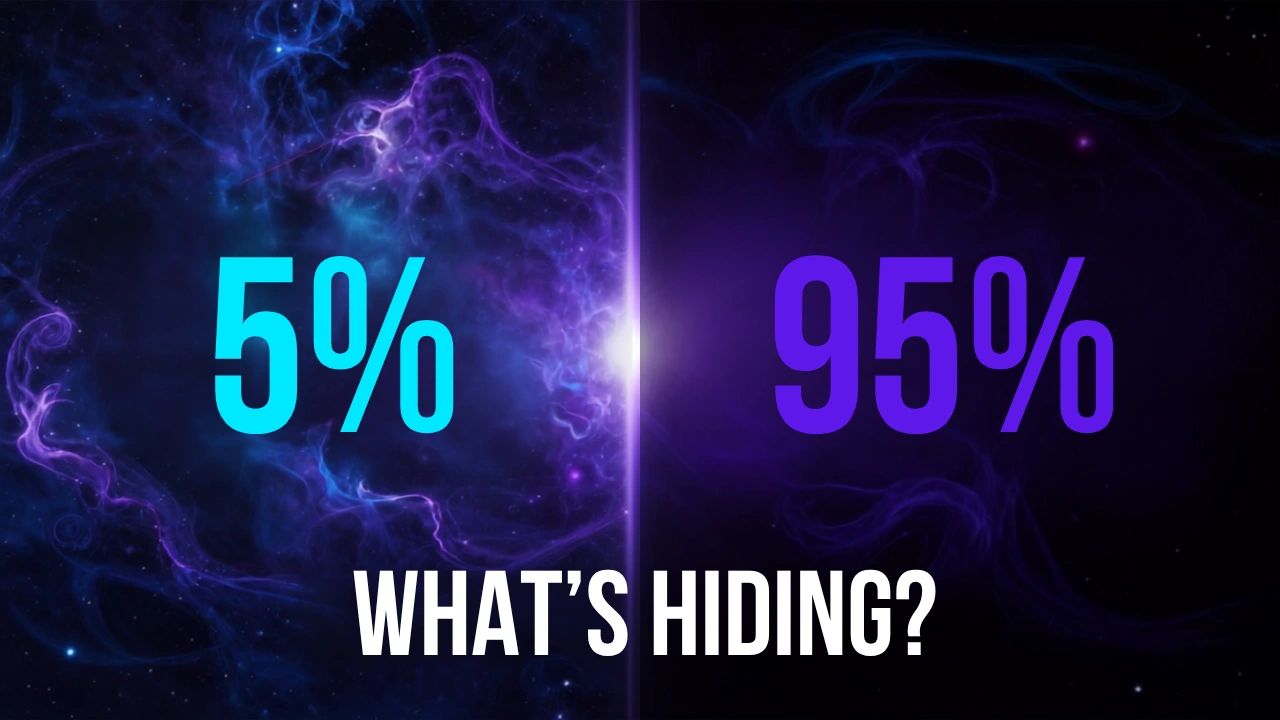
In fact, everything we can see—including stars, planets, galaxies, black holes, and even people—makes up only about 5% of the universe.
The remaining 95% consists of two mysterious components called dark matter and dark energy. Although scientists cannot see them directly, they know these invisible substances exist because of their powerful effects on galaxies and the expansion of the universe.
In this article, you’ll discover what makes up the universe, why most of it is invisible, and how astronomers continue searching for answers to one of science’s greatest mysteries.
What Makes Up the Universe?
Scientists divide the universe into three main components.
- 5% Ordinary Matter
- 27% Dark Matter
- 68% Dark Energy
Ordinary matter includes everything we can observe directly, such as:
- Stars
- Planets
- Galaxies
- Moons
- Asteroids
- Dust and gas
- Living organisms
Although this may sound like a lot, it represents only a tiny fraction of the entire universe.
What Is Ordinary Matter?
Ordinary matter is made of atoms.
Everything around us—including Earth, the Sun, your body, and distant galaxies—is built from atoms containing protons, neutrons, and electrons.
Scientists call this baryonic matter because it consists of the particles that form everyday objects.
This is the only part of the universe that emits, reflects, or absorbs light, making it visible to telescopes.
What Is Dark Matter?
Dark matter is one of the biggest mysteries in modern astronomy.
Unlike ordinary matter, dark matter does not emit, reflect, or absorb light. This makes it completely invisible.
Scientists cannot see dark matter directly, but they know it exists because of gravity.
Without dark matter:
- Galaxies would spin apart.
- Galaxy clusters wouldn’t stay together.
- The universe would look very different.
Current research suggests that dark matter makes up about 27% of the universe.
Although scientists have been studying dark matter for decades, they still don’t know exactly what it is made of.
What Is Dark Energy?
Dark energy is even more mysterious than dark matter.
It is believed to be the force responsible for the accelerating expansion of the universe.
Instead of pulling objects together like gravity, dark energy appears to push galaxies farther apart.
Scientists estimate that dark energy makes up about 68% of the universe, making it the largest known component of the cosmos.
Even today, researchers continue searching for clues about its true nature.
Internal Link Opportunity: Link the anchor text accelerating expansion of the universe to your article “The Universe Is Expanding Faster Than Ever.”
How Do Scientists Know Dark Matter Exists?
If dark matter is invisible, how can scientists be sure it’s real?
The answer lies in its gravitational effects.
Astronomers have observed that galaxies rotate much faster than they should.
Based on the amount of visible matter, galaxies should fly apart.
Instead, they remain held together by an invisible source of gravity.
This hidden mass is what scientists call dark matter.
Additional evidence comes from:
- Galaxy clusters
- Gravitational lensing
- Cosmic Microwave Background radiation
Together, these observations strongly support the existence of dark matter.
How Do Scientists Know Dark Energy Exists?
The discovery of dark energy came in the late 1990s.
Astronomers studying distant exploding stars, known as Type Ia supernovae, discovered that the universe wasn’t slowing down as expected.
Instead, it was expanding faster.
The only explanation that fit the observations was the existence of an unknown force pushing galaxies apart.
Scientists named this mysterious force dark energy.
Can We Ever See Dark Matter or Dark Energy?
At the moment, scientists cannot observe either directly.
Instead, researchers study their effects on galaxies, light, and cosmic expansion.
Powerful observatories such as the:
- James Webb Space Telescope
- Hubble Space Telescope
- Vera C. Rubin Observatory
continue collecting data that may eventually reveal the true nature of dark matter and dark energy.
Why Does This Matter?
Understanding the invisible universe could answer some of humanity’s biggest questions.
Scientists hope to learn:
- How galaxies formed
- Why the universe expands
- What happened after the Big Bang
- How gravity works on cosmic scales
- What is the ultimate fate of the universe
The answers may completely transform our understanding of physics.
Amazing Facts About the Invisible Universe
- Only about 5% of the universe is visible.
- Dark matter makes up approximately 27%.
- Dark energy accounts for roughly 68%.
- Scientists have never directly observed dark matter.
- Dark energy is causing the universe to expand faster over time.
- Everything humans have ever seen belongs to only 5% of the cosmos.
Even our neighboring planet, Venus, has unusual characteristics that continue to intrigue scientists.
What percentage of the universe can we see?
Scientists estimate that only about 5% of the universe consists of ordinary matter that can be directly observed.
What is the other 95% of the universe?
The remaining 95% is believed to consist of approximately 27% dark matter and 68% dark energy.
What is dark matter?
Dark matter is invisible matter that does not emit light but produces gravity, helping hold galaxies together.
What is dark energy?
Dark energy is a mysterious form of energy believed to drive the accelerating expansion of the universe.
Why can’t scientists see dark matter?
Dark matter does not interact with light, making it invisible to telescopes. Scientists detect it through its gravitational effects.
The universe is far more mysterious than it appears. Everything we can observe—from stars and planets to galaxies and people—accounts for only about 5% of the cosmos. The remaining 95% is made up of dark matter and dark energy, two invisible components that continue to challenge our understanding of space and physics.
As new telescopes and future space missions uncover more evidence, scientists move closer to solving one of the greatest mysteries in astronomy. Until then, the invisible universe remains one of the most fascinating frontiers of scientific discovery.