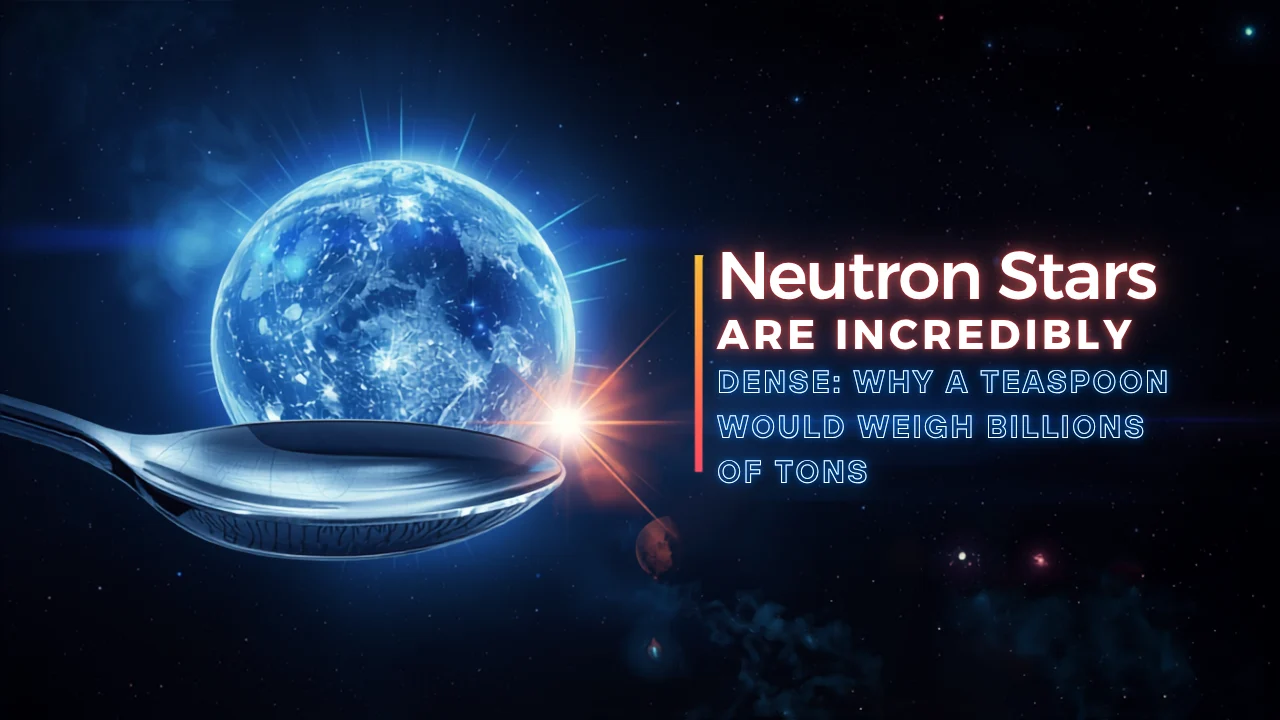
The universe is home to some of the most extraordinary objects imaginable. Among them, neutron stars stand out as one of the strangest and most fascinating creations of nature. These stellar remnants are so incredibly dense that a single teaspoon of neutron star material would weigh approximately 6 billion tons on Earth.
To put that into perspective, that’s heavier than many mountains and far beyond anything humans can experience in everyday life.
But what exactly is a neutron star? How does it form? And why is it so unbelievably dense?
Neutron stars are just one of the countless celestial objects that exist among the billions of stars spread throughout the universe.
What Is a Neutron Star?
A neutron star is the collapsed core of a massive star that has reached the end of its life cycle.
When a star much larger than our Sun runs out of nuclear fuel, it can no longer support itself against gravity. The star’s core collapses inward, triggering a massive explosion known as a supernova.
After the explosion, the remaining core becomes an extremely compact object called a neutron star.
Although neutron stars are only about 20 kilometers (12 miles) wide, they can contain more mass than our Sun.
This combination of enormous mass and tiny size creates one of the densest objects in the universe.
How Dense Is a Neutron Star?
The density of a neutron star is almost impossible to comprehend.
Scientists estimate that:
- One cubic centimeter of neutron star material weighs hundreds of millions of tons.
- A sugar-cube-sized piece would outweigh Mount Everest.
- A single teaspoon would weigh approximately 6 billion tons.
This extreme density occurs because nearly all the space between atoms has been crushed away.
The result is matter packed together more tightly than almost anywhere else in the universe.
How Are Neutron Stars Formed?
Neutron stars are born during one of the most violent events in the cosmos.
Step 1: A Massive Star Ages
Large stars continuously fuse elements in their cores to produce energy.
Step 2: Fuel Runs Out
Eventually, the star exhausts its nuclear fuel and can no longer resist gravity.
Step 3: Core Collapse
The core collapses rapidly under its own weight.
Step 4: Supernova Explosion
The outer layers explode outward in a brilliant supernova.
Step 5: Neutron Star Remains
The collapsed core survives as a neutron star.
This process can occur in stars that are approximately 8 to 25 times the mass of the Sun.
Massive stars eventually evolve into extraordinary objects such as neutron stars, highlighting the incredible diversity of the universe.
Why Are Neutron Stars So Dense?
The answer lies in their name.
Inside a neutron star, gravity becomes so powerful that protons and electrons are squeezed together.
This creates neutrons, which pack tightly into an incredibly small space.
Essentially:
- Atoms are crushed.
- Electrons and protons combine.
- Matter becomes almost entirely neutrons.
This transformation creates one of the densest forms of matter known to science.
How Big Is a Neutron Star?
Despite their enormous mass, neutron stars are surprisingly small.
Typical neutron stars have:
- Diameter: Around 20 kilometers (12 miles)
- Mass: About 1.4 times the Sun’s mass
- Surface Gravity: Up to 200 billion times stronger than Earth’s
If a neutron star replaced Earth, it would fit comfortably within a large city.
Yet it would still contain more mass than our Sun.
What Would Happen If You Visited a Neutron Star?
Visiting a neutron star would be impossible for humans.
The conditions are far too extreme.
Incredible Gravity
The gravitational pull is so strong that objects would be torn apart long before reaching the surface.
Intense Radiation
Many neutron stars emit powerful radiation that would be lethal to humans.
Extreme Magnetic Fields
Some neutron stars possess magnetic fields trillions of times stronger than Earth’s.
These conditions make neutron stars among the most hostile environments in the universe.
Pulsars: The Spinning Neutron Stars
Some neutron stars become pulsars.
A pulsar is a rapidly spinning neutron star that emits beams of radiation from its magnetic poles.
As the star rotates, these beams sweep across space like a lighthouse.
When the beam points toward Earth, astronomers detect a pulse of energy.
Some pulsars rotate hundreds of times every second, making them among the fastest-spinning objects in the universe.
Magnetars: The Most Powerful Magnets in the Universe
A special type of neutron star known as a magnetar possesses the strongest magnetic fields ever discovered.
These magnetic fields are so powerful that they can:
- Distort atoms
- Affect nearby spacecraft
- Release enormous bursts of energy
A magnetar’s magnetic field can be more than one trillion times stronger than Earth’s magnetic field.
Scientists continue studying these mysterious objects to better understand extreme physics.
Neutron Stars vs. Black Holes
Neutron stars and black holes are both formed from dying stars, but they are very different.
| Feature | Neutron Star | Black Hole |
|---|---|---|
| Size | Around 20 km wide | Can be much smaller or larger |
| Density | Extremely dense | Even denser |
| Surface | Has a solid surface | No visible surface |
| Light Escape | Yes | No |
| Gravity | Extremely strong | Strong enough to trap light |
If a collapsing star is massive enough, it may continue collapsing beyond the neutron star stage and become a black hole.
How Scientists Study Neutron Stars
Astronomers use advanced telescopes to observe neutron stars across different wavelengths.
These include:
- Radio telescopes
- X-ray observatories
- Gamma-ray detectors
- Space-based telescopes
Recent discoveries involving gravitational waves have also provided new insights into neutron star collisions.
These observations help scientists understand matter under conditions that cannot be recreated on Earth.
Why Neutron Stars Matter
Neutron stars are more than cosmic curiosities.
They help researchers study:
- Extreme gravity
- Nuclear physics
- Stellar evolution
- Gravitational waves
- The origins of heavy elements
Many elements found on Earth, including gold and platinum, may have been created during neutron star collisions.
This means some of the atoms in your body could trace their origins back to ancient stellar explosions.
A neutron star is the collapsed core of a massive star that exploded in a supernova.
Gravity compresses matter so tightly that protons and electrons combine into neutrons, creating extremely dense material.
A teaspoon of neutron star material would weigh approximately 6 billion tons on Earth.
No. They are much smaller but can contain more mass than the Sun.
Yes. If enough mass accumulates, a neutron star can collapse further and form a black hole.
Fascinating Facts About Neutron Stars
- A neutron star can spin hundreds of times per second.
- A teaspoon of neutron star material weighs around 6 billion tons.
- Neutron stars are born from supernova explosions.
- Some neutron stars become pulsars.
- Magnetars possess the strongest magnetic fields known.
- They are among the densest objects in the universe.
Neutron stars are among the most incredible objects in the universe. Born from the explosive deaths of massive stars, they pack more mass than the Sun into a sphere only about 20 kilometers wide. Their extraordinary density, immense gravity, and powerful magnetic fields challenge our understanding of physics and reveal just how strange the cosmos can be.
The next time you hear that a teaspoon of neutron star material would weigh billions of tons, remember that this isn’t science fiction—it’s one of the many astonishing realities of our universe.