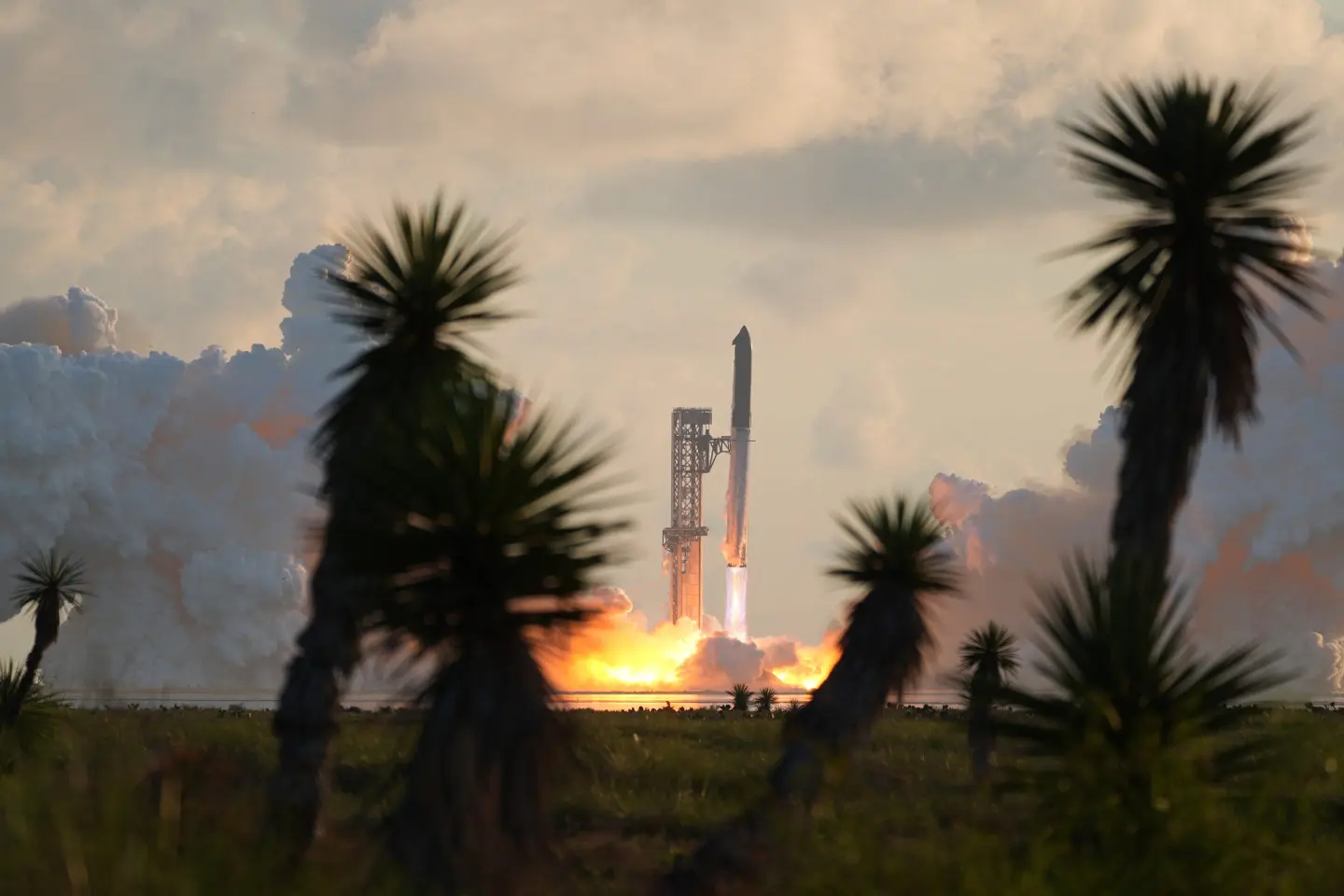
SpaceX is taking a different approach to rocket recovery. Instead of adding traditional landing legs to its massive Starship rocket, the company plans to use giant mechanical arms attached to a launch tower to catch the returning vehicle.
The system, often called Mechazilla, may look more complicated than landing a rocket on legs. However, it supports SpaceX’s long-term goal of building a fully reusable launch system that can fly frequently, carry heavy cargo, and reduce the cost of space travel.
The main reasons are weight savings, faster recovery, easier servicing, and fewer recovery systems on the rocket itself. SpaceX wants to recover both parts of Starship: the Super Heavy booster and the Starship upper stage, which is also called the Ship.
The company has already demonstrated tower catches of the Super Heavy booster. Catching the upper stage is a separate challenge that remains part of its development programme.
How Does SpaceX’s Starship Catching System Work?
“SpaceX Starship Super Heavy booster caught by Mechazilla launch tower chopstick arms Starbase”
Starship consists of two main stages. The Super Heavy booster provides the power needed to lift the rocket during launch, while the Starship upper stage continues the journey into space.
After separation, the booster turns back toward the launch site. It uses its engines and aerodynamic control surfaces to guide its descent and slow down before reaching the tower.
Two large mechanical arms extend from the launch tower. These arms, nicknamed chopsticks, are designed to catch the booster using specially designed contact points. If the operation succeeds, the booster remains suspended beside the tower rather than landing on the ground.
SpaceX can then use the launch infrastructure to inspect, service, and prepare the vehicle for another flight.
The upper stage follows a different flight path after separation. It must complete its mission, survive atmospheric re-entry, and return to a suitable recovery area. SpaceX intends to use tower catches for the Ship as well, but that requires additional development and testing.
The company explains that rapid reuse is central to its Starship plans. Recovering a vehicle at the launch site could reduce the work required to transport and prepare it for another mission.
1. Landing Legs Would Add Extra Weight
“SpaceX Starship Super Heavy booster enormous stainless steel rocket beside launch tower Starbase”
One of the biggest reasons SpaceX avoids landing legs is weight.
A rocket must carry its own structure, engines, fuel, and other equipment during launch. Every extra kilogram requires energy to accelerate. For a rocket designed to transport large payloads, reducing unnecessary mass can improve the amount of useful cargo it carries.
Landing legs need more than metal supports. They require hinges, locking systems, structural reinforcements, and mechanisms that allow them to deploy and withstand the forces of landing.
Those parts would travel with the rocket throughout launch and flight, even though they would mainly serve a purpose during the final moments of recovery.
SpaceX’s tower-catch approach moves much of that hardware to the ground. The tower’s mechanical arms stay at the launch site, so the rocket does not need to carry them into space.
The saved mass could provide more room in the vehicle’s performance budget for cargo, fuel, or other mission requirements. The actual benefit depends on the final vehicle design and operating conditions.
2. SpaceX Wants Faster Rocket Reuse
Traditional rocket recovery involves several steps. A booster lands, ground crews secure it, and the vehicle may need to be transported before technicians can inspect and prepare it for another flight.
SpaceX already reuses Falcon 9 boosters that land on legs. However, Starship is a much larger system, and the company wants to develop a different recovery process for its next-generation rocket.
A successful tower catch could leave the booster close to the launch mount and support equipment. This may reduce the need for cranes, transport operations, and separate landing facilities.
The company could then focus on inspections, refuelling, maintenance, and other tasks required before another launch.
SpaceX has not demonstrated aircraft-like turnaround times for Starship. The rocket remains under development, and each flight provides data that engineers use to improve the vehicle and its ground systems.
Still, rapid reuse is a major reason for the catching strategy. If SpaceX can repeatedly recover and prepare its vehicles with less work, it could support a higher launch rate over time. <Cite refs={[“turn407131search0″,”turn407131search8”]}/>
3. Landing Legs Would Be Difficult on Such a Large Rocket
“SpaceX Super Heavy booster standing vertically at Starbase launch mount giant stainless steel rocket”
Landing legs work well on Falcon 9, but Starship presents a different engineering challenge.
Super Heavy is an enormous booster. Its size and mass create major structural demands during landing. The legs would need to absorb the impact forces and keep the vehicle stable on the ground.
Engineers would also need to design a system that deploys reliably after launch, works in demanding conditions, and does not interfere with other rocket components.
For a vehicle of this scale, the legs and their supporting structure could become heavy and complex.
The tower catch transfers much of the final support task to equipment built specifically for the launch site. Instead of requiring the booster to stand on its own legs, the system supports it through dedicated contact points.
This approach introduces its own challenges. The booster must reach the correct position, move at a suitable speed, and align with the arms. The tower and its mechanisms must also handle the forces involved.
SpaceX is therefore trading one engineering problem for another. The benefit comes if catching proves lighter and more efficient at the system level.
4. Starship’s Heat Shield Makes Landing Legs More Complicated
The Starship upper stage faces another issue: atmospheric re-entry.
After returning from space, Starship must withstand intense heat. Its exterior uses a heat shield that includes ceramic tiles designed to protect the vehicle during re-entry.
Adding landing legs or other large deployable structures could create new design challenges. Engineers would need to protect the mechanisms from heat, fit them around the vehicle’s structure, and ensure they operate after the stresses of flight.
The lower part of the vehicle also contains engines and related equipment, which leaves limited room for additional hardware.
A tower catch offers a different option. The vehicle can be designed around dedicated catching points, while the larger support mechanism remains on the ground.
That does not remove the need for a reliable heat shield or precise control during descent. Starship still has to survive re-entry and arrive at the recovery point in a condition that allows a safe catch.
5. The Launch Tower Becomes Part of the Recovery System
“SpaceX Mechazilla launch tower chopstick arms catching Super Heavy booster at Starbase Texas”
SpaceX is not eliminating recovery hardware. It is moving a significant part of it from the rocket to the launch site.
The tower serves several purposes, including supporting launch operations and providing the arms used for catching. The surrounding infrastructure must also support vehicle stacking, propellant loading, testing, and servicing.
This arrangement could make recovery more efficient because the booster returns to the place where much of its launch preparation takes place.
However, the strategy depends on specialised ground infrastructure. A successful catch requires a compatible tower, suitable equipment, precise guidance, and a safe operating environment.
A rocket fitted with landing legs has more flexibility to land at a prepared pad or offshore recovery platform. A tower-caught rocket depends much more heavily on access to its dedicated catching system.
SpaceX must therefore make both the rocket and the ground equipment reliable enough to work together repeatedly.
6. Catching Could Reduce Recovery and Maintenance Work
Reusing a rocket is not just about bringing it back in one piece. The company must also inspect it, repair damage, replace parts when needed, and prepare it for the next mission.
A tower catch could simplify some of these tasks by returning the booster directly to the launch facility.
Ground crews may be able to access equipment and perform certain servicing tasks without moving the booster away from its recovery location. Over time, SpaceX could develop standard procedures for inspecting and preparing vehicles after each flight.
However, a catch does not automatically mean that a rocket is ready to fly again. Engineers still need to inspect its engines, structure, thermal protection where applicable, and other systems.
The benefits will depend on how much maintenance each flight requires and how quickly teams can complete the necessary checks.
SpaceX’s ultimate goal is not simply to catch a rocket. It is to make the complete launch-and-recovery process repeatable and efficient.
7. Has SpaceX Successfully Caught Starship Yet?
This distinction is important.
SpaceX has demonstrated successful catches of the Super Heavy booster, the first stage of the Starship launch system. The booster returns to the launch site and is caught by the tower’s mechanical arms.
The Ship upper stage is a separate vehicle with different recovery requirements. It must perform its mission, re-enter the atmosphere, and reach the catching area in a suitable condition.
In September 2026, Starship Flight 14 completed an orbital flight and deployed next-generation Starlink satellites, but the Ship ultimately splashed down in the Pacific Ocean rather than being caught by the tower.
That flight demonstrated progress, but it did not prove that upper-stage tower recovery is ready for routine use.
SpaceX plans to develop the system further. The company must show that it can recover both stages reliably before the complete reusable concept can deliver its intended benefits.
Catching Starship vs. Landing on Legs
| Feature | Traditional landing legs | Tower-catching system |
|---|---|---|
| Hardware location | Carried on the rocket | Much of the catching mechanism stays on the ground |
| Added vehicle weight | Requires legs and supporting structures | Avoids conventional landing legs for the catch configuration |
| Recovery location | Suitable landing pad or other prepared surface | Dedicated launch tower |
| Recovery operations | May require securing and transporting the vehicle | Could keep the vehicle near launch and servicing equipment |
| Main challenge | Strong, stable, reliable landing gear | Precise positioning and reliable tower mechanisms |
| Flexibility | Can support different prepared landing locations | Depends on compatible catching infrastructure |
Neither approach is automatically better for every rocket. Landing legs can provide greater recovery flexibility, while tower catching may offer advantages for a vehicle designed around frequent launches from dedicated facilities.
SpaceX’s choice reflects its particular priorities for Starship’s size, payload goals, and intended operating rate.
What This Means for Future Space Missions
Starship is being developed for several demanding roles, including launching satellites, transporting cargo, and supporting NASA’s plans for future lunar exploration.
A fully reusable launch system could help SpaceX reduce the resources needed for repeated flights. It could also support missions that require frequent launches, including transporting propellant to orbit for refuelling.
However, these goals depend on more than the catching system. SpaceX must also improve reliability, demonstrate safe operations, and develop the systems needed for complex missions.
For lunar missions, Starship will need to meet requirements that go far beyond returning to a launch tower. These include in-space refuelling, long-duration operations, and systems suitable for transporting astronauts and cargo.
The tower-catch strategy is one part of a much larger engineering programme.
Why SpaceX Is Betting on the Catching Method
SpaceX wants Starship to operate more like a reusable transportation system than a conventional rocket that requires extensive recovery work after each flight.
Landing legs would add weight and mechanical complexity to a vehicle already designed to carry large payloads. A tower catch moves much of that hardware to the ground and could allow a returning booster to remain close to its launch and servicing equipment.
The trade-off is that catching demands precise control and specialised infrastructure. It is a technically challenging process, and Starship’s upper-stage recovery system still needs further demonstration.
If SpaceX can make the process reliable, catching could help the company reach its long-term goal of frequent, lower-cost spaceflight. The real test will be whether it can repeat the operation safely and turn a successful recovery into a faster, more efficient next launch.