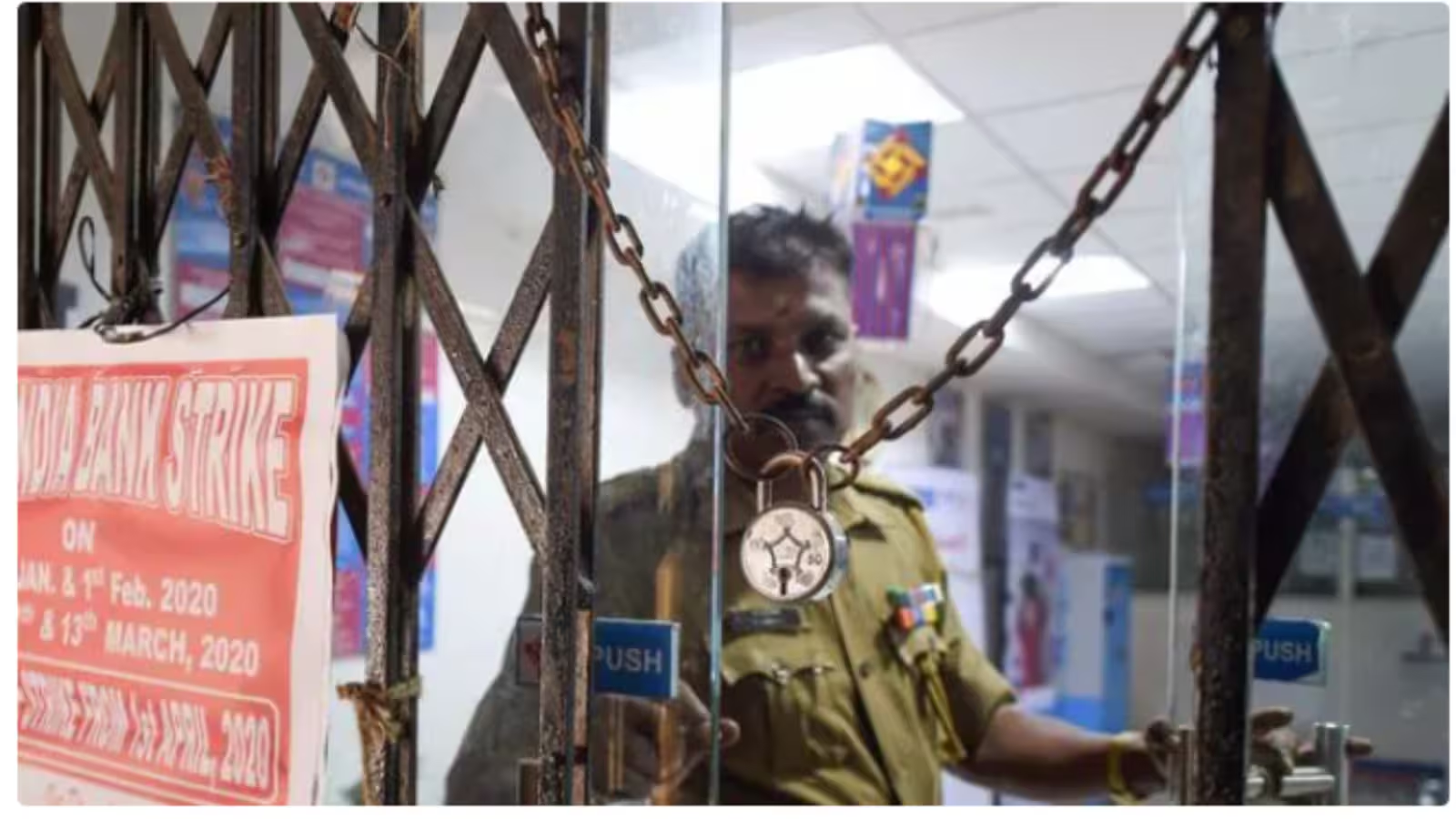
Bank customers across India may face disruption to branch services later this month as bank unions have announced a three-day nationwide bank strike from September 28 to September 30, 2026.
The strike has been called by the United Forum of Bank Unions (UFBU) and other participating banking unions. The main unresolved demand is the implementation of a five-day banking week.
The proposed strike comes after a one-day nationwide strike on September 11. A conciliation meeting held on September 22 between the unions, the Indian Banks’ Association (IBA), the Department of Financial Services (DFS), and bank management representatives did not produce a concrete agreement on five-day banking. UFBU has therefore maintained its September 28–30 strike programme.
For customers, the issue is important because September 26 is the fourth Saturday and September 27 is Sunday. If branch operations are affected by the strike, customers could face a longer gap in physical banking services around the weekend.
The situation may also be important for businesses because September 30 is the half-yearly closing date for banks.
Bank Strike September 28-30: What Is the Latest Update?
As of September 23, the three-day bank strike remains scheduled for September 28, 29 and 30.
UFBU said after the September 22 conciliation meeting that it would consider postponing the strike only if there was concrete and positive progress toward implementing a five-day banking week.
The government and banking management representatives have asked employees to avoid the strike and continue discussions.
The Finance Ministry has said the five-day workweek issue is still under consideration. It has also asked employees of public sector banks and regional rural banks to help maintain uninterrupted banking services.
Therefore, customers should prepare for possible branch-level disruption while watching for any last-minute change in the strike schedule.
Why Are Bank Unions Planning a Strike?
The main issue behind the current strike is the demand for a five-day banking week.
UFBU has said that five-day banking was agreed to as part of the wage revision settlement signed in March 2024 but has not yet been implemented.
During the September 22 conciliation meeting, the IBA and government representatives said the matter was still under consideration.
UFBU said it would reconsider the strike if there was clear progress on the issue. In the absence of such progress, the union forum said it would continue with the September 28–30 action.
The government has presented the situation differently. According to the Finance Ministry, the unions had raised two main demands: five-day banking and withdrawal of the Performance Linked Incentive (PLI) scheme.
The government says it has already kept the PLI scheme in abeyance. That leaves five-day banking as the main unresolved demand behind the current strike.
What Is a Five-Day Banking Week?
A five-day banking week would mean bank employees working five days a week instead of having regular working Saturdays in addition to weekdays.
Public sector banks already have the second and fourth Saturdays as holidays. The Finance Ministry noted that these Saturday holidays were introduced in 2015.
The remaining Saturdays currently provide another opportunity for customers who need branch-based banking services.
The unions want all Saturdays to become holidays as part of a five-day working week.
The government has said the proposal remains under consideration and that different stakeholders need to be considered before a decision is made.
Which Banks Could Be Affected?
The proposed action is a nationwide strike involving bank employee and officer unions.
Public sector banks have already issued customer advisories about possible disruption.
Banks including State Bank of India, Punjab National Bank, Union Bank of India, Bank of India and Indian Bank have communicated with employees or customers ahead of the proposed strike.
The exact effect can vary from one branch to another depending on employee participation and operational arrangements.
Customers should therefore avoid assuming that every branch will operate normally during the strike period.
Will Bank Branches Be Closed for Five Days?
The strike itself is scheduled for three days:
- September 28, 2026 — Monday
- September 29, 2026 — Tuesday
- September 30, 2026 — Wednesday
Before the strike, September 26 is the fourth Saturday and September 27 is Sunday.
This creates the possibility of a five-day gap in normal branch access from September 26 through September 30.
However, it is more accurate to describe this as a potential five-day disruption to branch services, rather than saying that every bank branch across India will definitely remain closed for five days.
The impact will depend on bank operations, employee participation, and any changes to the strike plan.
Why September 30 Is Important for Banks
The timing of the strike has added importance because September 30 is the half-yearly closing date for banks.
The Finance Ministry said the date is important for activities such as reconciliation, provisioning, treasury operations and market-related work.
A strike during this period could therefore create additional pressure on branch and back-office operations.
Businesses that have time-sensitive banking work should take this date into account when planning payments, documentation and other bank-dependent activities.
Which Banking Services Could Be Affected?
The main concern is with services that require a physical branch staff.
Customers may face delays with activities such as:
- Branch-based account services
- Physical document submission
- Certain loan-related work
- Employee-assisted banking services
- Some cheque-related processes
- Services requiring verification or physical paperwork
- Other transactions that normally require branch staff
The exact impact will depend on individual banks and branches.
The strike does not mean that every form of banking will stop.
Digital banking and self-service channels are expected to remain important alternatives.
Will UPI Work During the Bank Strike?
Customers can continue to use digital payment methods such as UPI for routine transactions where the relevant bank and payment services are available.
Banks have advised customers to use digital channels during the proposed strike.
SBI, for example, has asked customers to use internet banking, YONO, mobile banking, UPI and other digital services. It has also suggested ATMs, Automated Deposit and Withdrawal Machines, and Customer Service Points for certain requirements.
However, customers should remember that digital services cannot replace every branch service.
If a transaction requires physical documents, staff assistance, or branch verification, it may need to be completed before the strike.
Will ATMs Work During the Bank Strike?
ATMs are expected to remain an important option for customers during the strike period.
SBI has specifically advised customers to use ATMs and Automated Deposit and Withdrawal Machines for cash requirements.
Other banks have also directed customers toward self-service channels.
Still, customers should avoid waiting until the last moment for important cash requirements. ATM availability and cash levels can vary by location.
Planning can reduce the need for an urgent branch visit during the strike period.
What Should SBI Customers Do?
SBI has issued an advisory asking customers to complete important banking transactions before the proposed strike.
The bank has suggested using:
- ATMs
- Automated Deposit and Withdrawal Machines
- Customer Service Points
- Internet banking
- YONO
- Mobile banking
- UPI
- Other digital banking channels
Customers who need branch-based services should therefore plan those transactions before September 28.
What About PNB and Other Public Sector Banks?
Other public sector banks have also prepared customers for possible disruption.
PNB, Union Bank of India, Bank of India and Indian Bank are among the lenders that have communicated with employees or customers about the proposed strike.
The general advice is similar: complete important physical banking work early and use digital or self-service channels where possible.
Customers should also check their own bank’s website, mobile app or official customer communication for the latest information.
What Has the Government Said?
The Finance Ministry has asked employees of public sector banks and regional rural banks to avoid the strike.
In its September 21 statement, the government said it had already addressed one of the two major demands by keeping the PLI scheme in abeyance.
It also said the five-day banking proposal remains under examination.
The government has urged unions to continue discussions and ensure that banking services remain available to customers.
This is the government’s stated position. The unions, meanwhile, say they have not received sufficient progress on five-day banking and have maintained their strike call.
What Are Bank Unions Saying?
UFBU says five-day banking remains unresolved.
Following the September 22 conciliation meeting, the union forum said it would proceed with the September 28–30 strike unless there was concrete progress toward implementation of its demand.
The unions have also linked their demand to the March 2024 wage revision settlement, saying the five-day banking arrangement was agreed to at that time.
The two sides therefore continue to differ over the status and implementation of the proposal.
Could There Be Another Bank Strike in October?
There is also a longer-term concern for customers.
The Finance Ministry’s September 21 statement said an indefinite strike has been proposed from October 26, 2026, with five-day banking as the remaining demand.
This does not mean that an indefinite strike will definitely take place.
The October action remains a proposed future step and could change if discussions produce an agreement.
Customers should therefore follow official announcements instead of treating the October date as a confirmed closure period.
What Businesses Should Do Before September 28
Businesses that depend on branch services should plan.
Companies may want to review upcoming:
- Bank deposits
- Physical cheque transactions
- Loan-related documentation
- Account-related paperwork
- Time-sensitive bank submissions
- Payments requiring branch assistance
- Other transactions that cannot be completed online
The timing is particularly relevant for companies with September 30 financial deadlines.
The Finance Ministry has highlighted the importance of September 30 for bank reconciliation, provisioning, treasury and market operations.
Completing important branch work early can help businesses avoid unnecessary delays.
What Individual Customers Should Do
Customers do not need to stop using banking services.
Instead, they should identify which services require a branch and which can be completed digitally.
Complete Branch Work Early
If you need a physical branch for an important transaction, try to complete it before September 28.
Check Your Digital Banking
Make sure your mobile banking and internet banking access is working before the strike.
Plan Cash Requirements
If you expect to need cash, plan your withdrawal rather than waiting for the strike period.
Keep Alternative Payment Options Ready
UPI and other digital payment methods can help with routine payments where available.
Check Bank Advisories
Banks may issue updated notices if the strike schedule changes or if special arrangements are introduced.
Does the Strike Affect Private Banks?
The proposed strike is centered on unions representing employees and officers in public sector banking, with support from regional rural bank organisations.
Private banks may not be affected in the same way.
Customers should therefore check the specific status of their bank rather than assuming that all banks will have identical operations.
The Department of Financial Services lists India’s public sector banks separately, including SBI, PNB, Bank of Baroda, Canara Bank, Union Bank of India, Indian Bank and others.
What About Regional Rural Banks?
Regional Rural Banks, or RRBs, also form part of the wider banking workforce covered by the government’s appeal.
The Finance Ministry has referred specifically to public sector banks and regional rural banks in its request for uninterrupted banking services.
RRB customers should therefore check their own bank’s notice before planning a branch visit during the strike period.
What Happens Next?
The September 28–30 bank strike remains the key immediate issue for customers and businesses.
The unions have maintained their strike call because they say there has been no concrete progress on five-day banking. The government and banking management have asked employees to avoid the strike and continue discussions.
For customers, the practical step is to plan.
Important branch-based work should be completed before the strike dates where possible. Digital banking, UPI, mobile banking and ATMs can provide alternatives for many routine transactions.
The final impact will depend on developments between the unions, government and bank management before September 28.
For now, customers should follow official updates from their own bank and plan time-sensitive banking work accordingly.