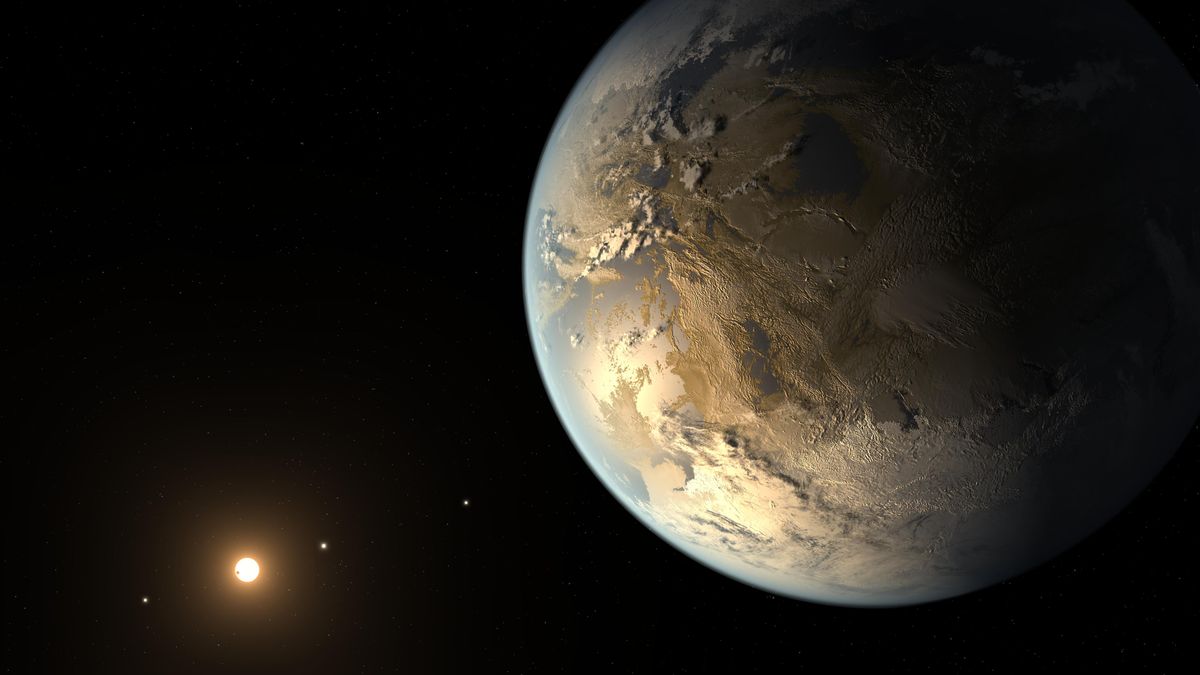
For many years, Earth has been the main example scientists use when searching for life beyond our planet. It has liquid water, a protective atmosphere, a suitable temperature range, and millions of known living species. However, scientists are now exploring an interesting possibility: some planets beyond our solar system could offer even better conditions for life than Earth.
These potential worlds are often called superhabitable planets. Researchers believe that certain planets may have advantages such as more stable climates, longer periods of suitable conditions, and environments that could support life more easily.
The idea does not mean scientists have discovered another planet filled with life. Instead, it offers a new way to search for places where living organisms might develop and survive. Research published in 2025 explored how planets around certain orange dwarf stars could provide favorable conditions for life and be promising targets for future observations.
What Are Superhabitable Planets?
A superhabitable planet is a world that could provide more favorable conditions for life than Earth. The term is used by researchers to explore whether some planetary environments might support life more effectively than our own.
Earth provides the only confirmed example of a planet that supports life. Scientists therefore use it as a reference when studying distant worlds. However, this approach may overlook planets with different environments that could be equally suitable or even better for certain forms of life.
For example, a planet with a slightly larger surface area, shallow oceans, and a stable climate might offer more environments for living organisms. A world orbiting a long-lived star could also have more time for life to develop.
Researchers Dirk Schulze-Makuch, René Heller, and Edward Guinan explored this idea in a 2020 study published in the journal Astrobiology. They identified 24 potential candidates for superhabitability among the thousands of exoplanets known at the time. These were candidates for further study, not confirmed homes for life.
Why Could Some Planets Be Better Than Earth?
Scientists consider several factors when assessing whether a planet could offer favorable conditions for life. No single feature can prove that a planet is habitable, but a combination of suitable characteristics can make a world worth investigating.
1. A Stable Climate
A stable climate may help living organisms survive over long periods. On Earth, changes in temperature, atmospheric composition, and ocean conditions have influenced the development of life throughout history.
Some researchers suggest that a planet with a relatively stable environment could provide more time for complex life to develop. A suitable atmosphere, the presence of liquid water, and natural processes that regulate temperature could all play important roles.
However, a planet’s climate depends on many factors, including its atmosphere, surface conditions, oceans, and the energy it receives from its star. Scientists need more information before they can determine whether a distant planet has a stable environment.
2. A Planet That Is Slightly Larger Than Earth
A planet that is somewhat larger than Earth could potentially have advantages. Depending on its composition, it might retain heat for longer or support a thicker atmosphere.
Some larger rocky planets may also have greater geological activity, which could help recycle important elements and regulate atmospheric conditions.
However, size alone does not determine habitability. If a planet becomes too large, it may have a deep atmosphere dominated by gases or other conditions that make it very different from Earth.
Scientists therefore need to understand a planet’s mass, density, composition, and atmosphere before deciding whether it could support life.
3. More Suitable Conditions for Liquid Water
Liquid water is a major priority in the search for life because all known life on Earth depends on it.
Scientists often begin by looking for planets in the habitable zone of their stars. This is the region where temperatures could allow liquid water to exist on a planet’s surface, provided the planet has suitable atmospheric conditions.
NASA explains that being in the habitable zone is only a starting point. A planet must also have other suitable conditions, such as an atmosphere capable of supporting a favorable environment. <Cite refs={[“turn815661search0″,”turn815661search1”]}/>
A world with extensive shallow oceans and suitable nutrient supplies might provide different opportunities for life than Earth’s deep oceans. Still, researchers cannot determine the actual availability of water simply from a planet’s distance from its star.
Why Are Orange Dwarf Stars Important?
One of the most interesting ideas in superhabitability research involves planets orbiting K-type dwarf stars, also known as orange dwarfs.
These stars are generally cooler and less massive than the Sun. They can remain stable for long periods, making them interesting targets in the search for planets that could support life.
A long-lived star may give life more time to develop, provided its planets have the right environmental conditions. This is one reason researchers are interested in planets around K-type stars rather than focusing only on worlds that closely resemble Earth.
A 2025 study examined modeled superhabitable planets around mid-type K dwarf stars. The researchers investigated how the amount of energy received from a star could affect surface conditions and the ability of future telescopes to study planetary atmospheres. Their modeling identified certain scenarios that may be especially promising for habitability research.
This research does not establish that planets around orange dwarfs are automatically more habitable. Each planet needs to be studied individually, and scientists still need evidence about its atmosphere and surface environment.
How Do Scientists Search for Habitable Planets?
Scientists use several methods to discover and study planets outside our solar system. These planets are known as exoplanets.
The Transit Method
The transit method looks for a small decrease in a star’s brightness when a planet passes in front of it.
By measuring these changes, astronomers can identify possible planets and estimate their sizes. Repeated observations can also help determine how long a planet takes to orbit its star.
NASA’s Kepler mission and the Transiting Exoplanet Survey Satellite, or TESS, have helped researchers discover many exoplanets using this method.
Studying Planetary Atmospheres
Finding a planet is only the first step. Scientists also want to learn what its atmosphere contains.
When a planet passes in front of its star, some starlight may travel through the planet’s atmosphere before reaching a telescope. Researchers can study this light to identify chemical signatures associated with different gases.
The James Webb Space Telescope can investigate the atmospheres of selected exoplanets. These observations may help scientists understand temperature, atmospheric composition, and other conditions relevant to habitability.
Looking for Signs of Life
Scientists also search for possible biosignatures, which are substances or patterns that could be associated with biological activity.
Certain gases may be interesting if they appear together in combinations that are difficult to explain through non-biological processes. However, no single chemical detection should automatically be treated as proof of life.
Researchers must consider geological processes, atmospheric chemistry, and other possible explanations before reaching conclusions.
Examples of Planets Scientists Are Studying
Several known exoplanets have attracted attention because of their size, temperature estimates, or position within the habitable zone. Their inclusion in this discussion does not mean they have been confirmed as superhabitable.
Kepler-1649c: NASA reported in 2020 that this planet is close to Earth in size and receives about 75% of the starlight Earth receives from the Sun. It orbits a red dwarf approximately 300 light-years away. Its host star’s activity could create challenges for habitability.
TOI 700 d: This Earth-sized planet orbits within the habitable zone of its star. NASA’s TESS mission discovered it, and further observations helped confirm the planet. Scientists have modeled possible environments, but its actual surface conditions remain uncertain.
HD 137010 b: NASA discussed this possible rocky planet in January 2026. It may be slightly larger than Earth and orbit a Sun-like star about 146 light-years away. However, it remains a planet candidate, and its estimated temperature could be extremely cold.
These examples show why scientists must distinguish between finding a planet in an interesting orbit and proving that it has conditions suitable for life.
Could These Planets Support Life Better Than Earth?
It is possible that some distant planets could have environments that are more favorable to certain forms of life. However, scientists do not yet know whether any planet is truly more habitable than Earth.
A planet could have liquid water but lack the nutrients needed for life. Another might have a suitable temperature but experience powerful stellar radiation. Even a planet with a promising atmosphere might have an inhospitable surface.
Earth itself demonstrates how many factors can work together to support a living world. Its atmosphere, oceans, magnetic field, geological processes, and relationship with the Sun all influence its environment.
Scientists must therefore study a wide range of planetary features instead of relying on a single measurement or a simple Earth-like comparison.
What Role Will Future Space Telescopes Play?
Future observations will be important for testing the idea of superhabitable planets.
The James Webb Space Telescope is already studying selected exoplanet atmospheres. Future missions, including NASA’s planned Habitable Worlds Observatory, are intended to advance the search for potentially habitable worlds and possible signs of life.
Better instruments may help astronomers study smaller planets, identify atmospheric gases, and compare the conditions found around different types of stars.
These observations could also help scientists refine their definition of habitability. Instead of searching only for planets that resemble Earth, researchers may begin to give greater attention to worlds with different but potentially favorable environments.
The Search for Life Beyond Earth Continues
The possibility of planets that are more habitable than Earth gives scientists a broader way to investigate the universe. It encourages researchers to look beyond familiar conditions and consider how different stars, atmospheres, and planetary environments might support life.
For now, Earth remains the only world known to support life. But as telescopes improve and astronomers learn more about distant planets, researchers may discover environments that offer new clues about how life begins and survives.
The most important next step is to move from theoretical predictions to direct observations. By studying planetary atmospheres, surface conditions, and possible biosignatures, scientists can begin to determine which distant worlds deserve the closest attention.