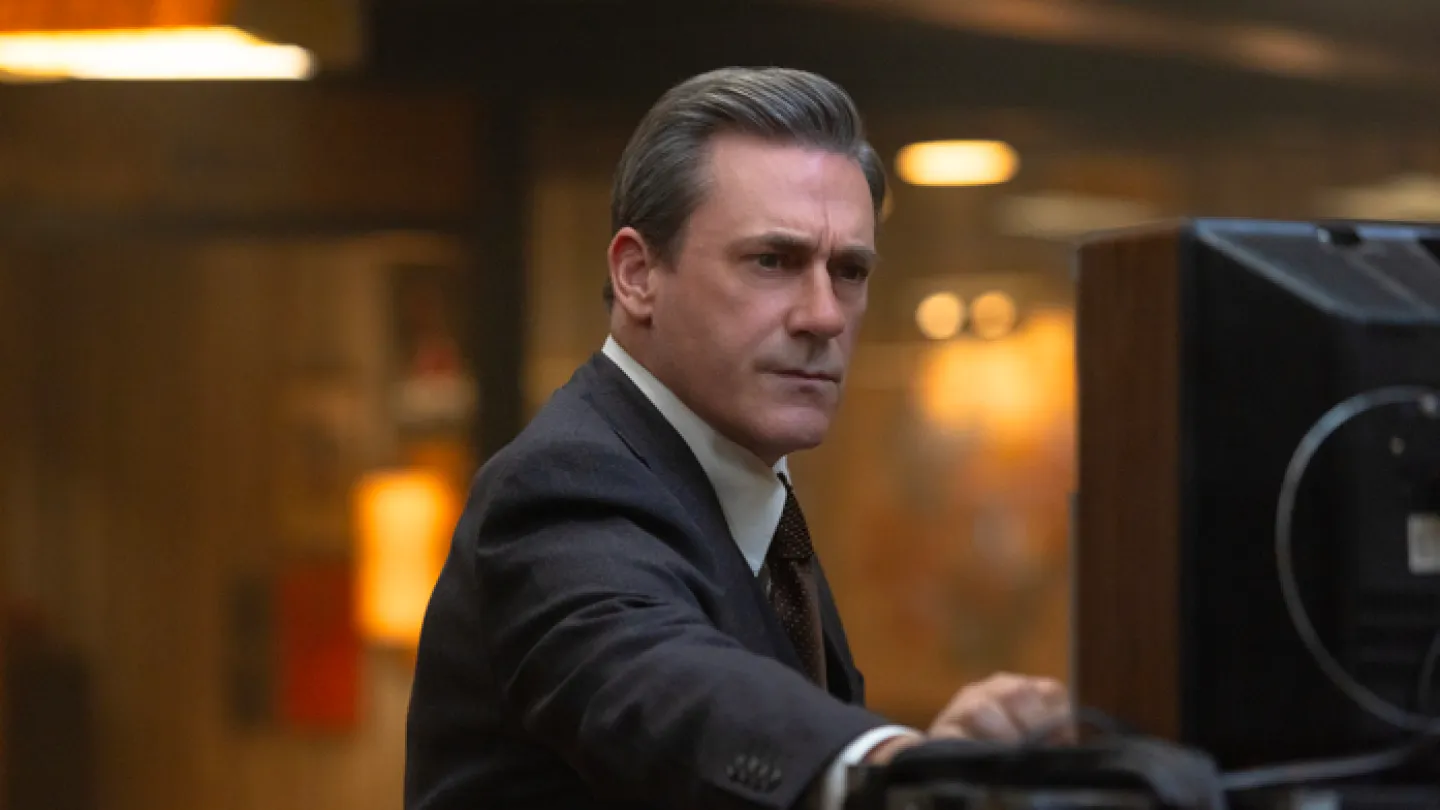
Jon Hamm is returning to a tense period in American history with American Hostage, a new psychological thriller based on a real 1977 hostage crisis. While the story takes place nearly 50 years ago, Hamm believes the series has a strong connection to the world people are living in today.
The actor stars as Fred Heckman, an Indianapolis radio reporter who suddenly finds himself at the center of a dangerous hostage situation. The series explores what happens when a violent crisis becomes a media event and when a person with a grievance finds a powerful way to reach the public.
For Hamm, that connection between crime, media attention, public anger and politics is one reason American Hostage feels especially relevant in the current political climate.
The eight-episode series is based on the first season of the scripted podcast of the same name. MGM+ is set to premiere the series on September 20, 2026.
What Is American Hostage About?
American Hostage tells the story of Fred Heckman, a popular Indianapolis radio reporter whose normal working day turns into a terrifying crisis.
The story is based on an actual incident that happened in Indianapolis in 1977. Tony Kiritsis, a real-estate developer, took mortgage broker Richard O. Hall hostage after becoming angry over a financial dispute. Kiritsis used a shotgun and a so-called dead-man’s mechanism that made the situation extremely dangerous. The standoff continued for about 63 hours.
In the television version, Jon Hamm plays Fred Heckman, the radio journalist who becomes closely connected to the crisis.
Giovanni Ribisi plays Tony Kiritsis, while the cast also includes Mireille Enos, William Jackson Harper, Kristoffer Polaha, Jonathan Tucker and Kat Cunning. Hamm is also an executive producer on the series.
The story is not simply about a hostage and the police. It is also about the media’s role in a crisis.
Kiritsis demands to be heard through Heckman’s radio program. That puts the journalist and his colleagues in a difficult position. Giving him airtime could help keep the situation under control, but it could also give a dangerous person exactly what he wants: a large audience.
That question remains important today because news can reach millions of people within seconds.
Why Jon Hamm Says the Story Feels Relevant Today
The biggest reason American Hostage feels modern is not necessarily the hostage situation itself. It is the way a person can use media attention to influence the public.
In the 1970s, radio was one of the fastest ways for a person to reach a large audience. Today, people can use television, social media, livestreams, podcasts and other digital platforms to get attention.
That makes the basic question behind the story very familiar: What happens when someone in a crisis is given a platform?
Hamm has described the material as feeling particularly relevant to the current political climate. His comments point toward a larger issue surrounding public anger, distrust and the way information spreads.
The series therefore has an opportunity to look at more than a crime from the past. It can also encourage viewers to think about how Americans consume news and how quickly a private grievance can become a public spectacle.
A 1970s Story With a Modern Media Problem
One of the most interesting parts of American Hostage is the contrast between its setting and its themes.
The series takes place in the 1970s, long before smartphones and social media. There were no viral posts, livestreams or online comment sections.
Yet the media pressure in the story feels familiar.
Tony Kiritsis wants people to hear his side of the story. His hostage situation becomes a public event because he finds a way to communicate through radio.
That idea has only become more powerful in the digital age.
Today, almost anyone can publish a video, make a statement online or speak directly to a large audience. A dramatic event can become a national conversation almost immediately.
This does not mean the situations are identical. The technology is very different, and the circumstances surrounding the 1977 case are specific to that time.
But the central issue remains recognizable: attention can become a form of power.
The Role of Journalism in American Hostage
Fred Heckman’s role makes the series particularly interesting for viewers interested in journalism.
He is not a police officer or a government official. He is a journalist who suddenly becomes part of a crisis.
That creates difficult questions about professional responsibility.
Should a journalist give a hostage-taker airtime?
Can broadcasting a suspect’s demands help save a life?
When does reporting become participation?
And what happens when an audience becomes more interested in the dramatic story than the facts behind it?
These questions are not limited to the 1970s.
Modern journalists face similar challenges when covering violent crimes, political unrest, public emergencies and other breaking events. The speed of today’s news cycle can make those decisions even harder.
A story can spread online before journalists have enough time to verify every detail.
American Hostage approaches these questions through a fictionalized television drama based on a real event. That gives the show room to explore the human and professional pressure surrounding the crisis.
The Real Story Behind American Hostage
The real 1977 incident is important for understanding the series.
On February 8, 1977, Tony Kiritsis entered a mortgage company in Indianapolis and took Richard O. Hall hostage. Kiritsis was angry over a real-estate loan and blamed Hall for his financial problems.
According to reporting on the historical incident, Kiritsis connected Hall to a shotgun using a dangerous mechanism designed to make any sudden move potentially deadly. Police were forced to approach the situation carefully while trying to keep the hostage-taker calm.
The crisis lasted approximately 63 hours.
One of the unusual aspects of the case was Kiritsis’ relationship with the media. He used radio to communicate his grievances and attract public attention.
That media element is central to the television series.
Rather than simply showing the hostage crisis from the perspective of law enforcement, American Hostage puts the radio journalist near the center of the story.
Jon Hamm Brings Another Period Role to Television
Jon Hamm is particularly well suited to a period drama because of his long association with Mad Men, the acclaimed series set in the 1960s.
However, Fred Heckman is very different from Don Draper.
Instead of playing a powerful advertising executive, Hamm plays a journalist who unexpectedly finds himself trapped inside a dangerous situation.
The role also allows Hamm to explore a more ordinary person dealing with extraordinary pressure.
Fred is not prepared to become the public face of a hostage crisis. His job is to report the news, but suddenly the news is happening around him.
That creates a different kind of tension for the character.
Hamm’s involvement also goes beyond acting. He serves as an executive producer, giving him a role in shaping the project as well as performing in it.
Giovanni Ribisi Plays the Hostage-Taker
Giovanni Ribisi plays Tony Kiritsis, the man at the center of the hostage crisis.
Kiritsis is not presented simply as a traditional villain. The story examines the anger and personal problems that helped push him toward the extreme action.
That does not excuse what he did.
Instead, it provides a way for the series to explore how personal frustration can become dangerous when combined with a desire for public attention.
This is another area where the story can connect with modern conversations about media and public behavior.
People often see only the final dramatic event. Understanding what happened before it can be more complicated.
American Hostage and the Power of Public Attention
Public attention is one of the strongest themes in the story.
Kiritsis does not simply want his demands met. He wants his complaints heard.
That distinction matters.
A person may have a legitimate grievance, an exaggerated grievance or a completely false belief. But once that person gains a large platform, the audience may begin discussing the message rather than questioning the behavior behind it.
This is particularly important in today’s media environment.
Social platforms can reward dramatic behavior because strong reactions often generate more views, comments and shares.
Again, American Hostage is not a direct story about social media. Its events happened decades before social platforms existed.
But its central media question is surprisingly current.
Why the Political Connection Matters
The phrase “current political climate” can mean different things to different viewers. The series does not need to represent one political party or one particular political argument to feel politically relevant.
Its relevance comes from broader issues such as public distrust, anger, polarization, media influence and the struggle over who gets heard.
Those issues have become important parts of political discussion in the United States.
The real hostage crisis also belongs to a period of major social and political change in America. The country was dealing with economic pressure, distrust in institutions and major changes in the relationship between citizens and the media.
That historical background gives the series more depth than a simple crime thriller.
At the same time, viewers should remember that American Hostage is a scripted drama based on real events. Television adaptations can condense events, combine characters or dramatize conversations to tell a compelling story.
The real historical record remains the best source for understanding what actually happened.
American Hostage Is Also About How News Has Changed
The series provides an interesting way to compare journalism across generations.
In 1977, radio was a major source of breaking information. A reporter could become nationally known because of a live broadcast.
Today, the same type of event might appear simultaneously on television, websites, social media platforms, podcasts and livestreams.
The technology has changed dramatically.
The basic challenge has not.
Journalists still have to decide what information is useful to the public, what should be broadcast and how much attention should be given to people involved in dangerous situations.
The difference is that today’s news environment moves much faster.
A mistake made during a live broadcast can be copied and shared thousands of times before there is time to correct it.
That makes the questions raised by American Hostage particularly timely.
When Does a Crisis Become Entertainment?
Another important question is where the line between news and entertainment should be drawn.
The 1977 hostage situation attracted significant public attention. People wanted to know what was happening, but the more attention the event received, the more powerful the media became in shaping the public’s understanding of it.
That tension is still visible today.
Breaking news can quickly become a form of entertainment when audiences follow every update, reaction and dramatic development.
The danger is that the human cost can become secondary to the excitement of the story.
A responsible news system has to balance public interest with accuracy, safety and respect for people involved.
This is one of the reasons American Hostage can work as more than a traditional thriller.
American Hostage Release Date and Where to Watch
American Hostage is an eight-episode psychological thriller from MGM+. The series is scheduled to premiere on September 20, 2026, with new episodes following weekly.
The series was created by Shawn Ryan and Eileen Myers and is based on the scripted American Hostage podcast. The podcast itself also featured Jon Hamm as Fred Heckman and tells the same 1977 hostage story.
The television adaptation expands that story for a visual audience while keeping the focus on the hostage crisis, journalism and the people caught in the middle.
What is American Hostage about?
American Hostage is a psychological thriller based on the real 1977 Indianapolis hostage crisis involving Tony Kiritsis and mortgage broker Richard O. Hall. Jon Hamm plays radio reporter Fred Heckman, who becomes involved in the crisis when Kiritsis demands media attention.
Who does Jon Hamm play in American Hostage?
Jon Hamm plays Fred Heckman, an Indianapolis radio reporter. Hamm also serves as an executive producer on the series.
Is American Hostage based on a true story?
Yes. The series is based on the real 1977 hostage crisis in Indianapolis. It is also adapted from the scripted American Hostage podcast.
Who plays Tony Kiritsis?
Giovanni Ribisi plays Tony Kiritsis, the hostage-taker at the center of the story.
When does American Hostage premiere?
American Hostage is scheduled to premiere on MGM+ on September 20, 2026. The series has eight episodes.
Why does Jon Hamm think American Hostage is relevant today?
The story explores issues involving media attention, public anger, communication and the way a crisis can become a public spectacle. Those themes can feel familiar in today’s highly connected political and media environment.
Is American Hostage connected to the movie Dead Man’s Wire?
Both projects are based on the same 1977 hostage incident involving Tony Kiritsis. However, American Hostage places greater attention on radio reporter Fred Heckman and the media side of the crisis, while Dead Man’s Wire focuses more directly on Kiritsis.
What Makes American Hostage Worth Watching?
There are several reasons viewers may want to watch American Hostage.
First, it is based on a remarkable real event. A 63-hour hostage situation involving a radio journalist already provides a strong foundation for a thriller.
Second, Jon Hamm brings experience from major television dramas and another well-known period series, making the role a natural but different continuation of his television career.
Third, the story raises questions that are still relevant. How should the media cover a crisis? Should dangerous people be given a platform? How does public attention change a situation? And what happens when personal anger becomes a public performance?
Those questions make the series more than a historical recreation.