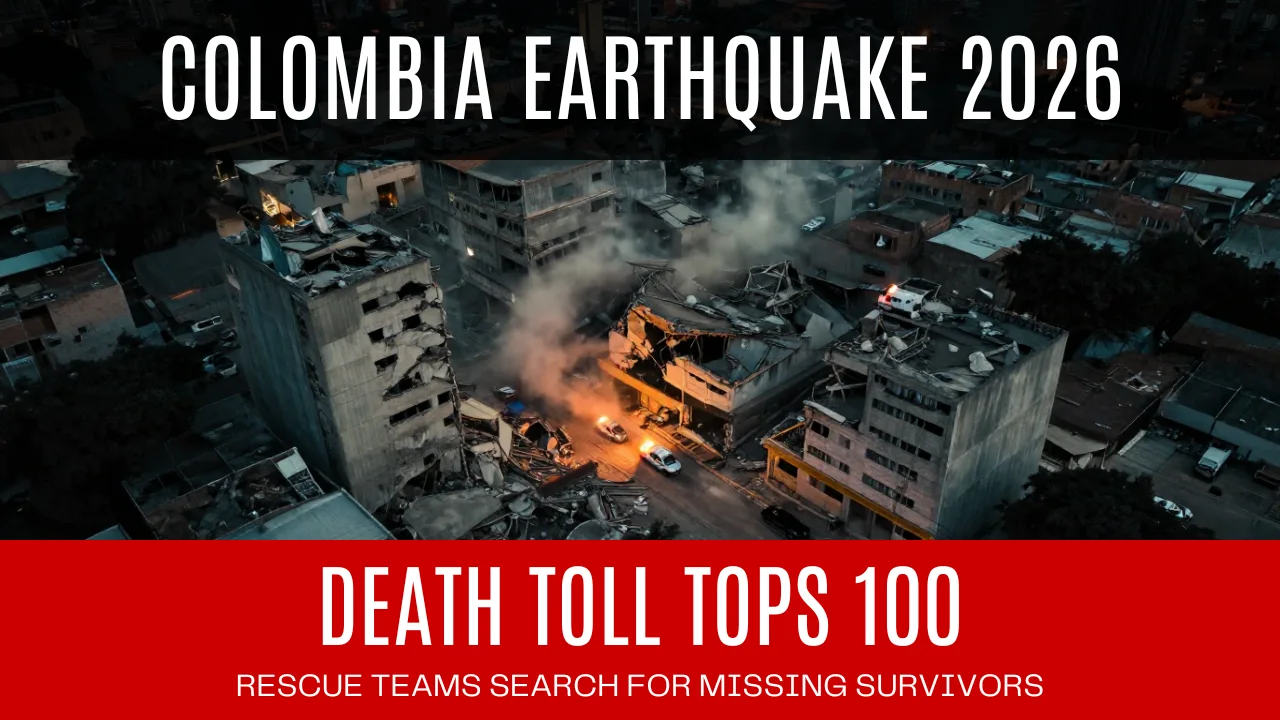
A powerful 7.4-magnitude earthquake struck western Colombia, leaving a trail of destruction across several cities and towns and triggering a major search-and-rescue operation. More than 100 people have been reported dead, hundreds have been injured, and rescue teams are continuing to search collapsed buildings for people who may still be trapped.
The earthquake struck on Monday, August 10, 2026, with its epicenter near San José del Palmar in the Chocó region, according to reports citing the U.S. Geological Survey and Colombian authorities. The earthquake occurred at a depth of about 107 kilometers and was felt across a wide area, including Bogotá and neighboring countries.
As emergency crews work through damaged buildings, the full scale of the disaster remains unclear. Authorities have warned that the death toll could rise as rescue workers reach areas that are difficult to access.
Powerful Colombia Earthquake Causes Widespread Destruction
The earthquake was one of the strongest to strike Colombia in recent decades. Its magnitude and widespread impact caused serious damage to buildings, roads, hospitals, airports, and other important infrastructure.
Reports indicate that around 1,600 buildings were damaged, while dozens completely collapsed. Western cities including Cali, Pereira, Quibdó, and Manizales were among the areas affected.
The destruction has made rescue operations difficult.
In some locations, emergency workers have had to move through unstable structures while searching for survivors. Heavy equipment is being used to clear rubble, but rescuers must work carefully because damaged buildings can collapse further.
The situation is particularly challenging in remote parts of Chocó, where difficult terrain and communication problems have slowed efforts to assess the damage.
Death Toll Rises Above 100
The number of people killed in the earthquake has continued to increase as authorities investigate damaged areas.
The latest reports available on August 11 put the confirmed death toll at at least 111 people, although some reports have given higher figures as authorities continue verifying casualties.
Hundreds of people have also been injured.
Officials expect the numbers to change as search teams enter more damaged buildings and receive information from communities that have been difficult to reach.
This is why casualty figures following a major earthquake should be treated as provisional during the early stages of rescue operations.
Thousands of People Reported Missing
One of the biggest concerns is the number of people who have not yet been located.
Reports have described thousands of people as missing or unaccounted for, particularly in some of the hardest-hit areas.
However, being listed as missing does not necessarily mean someone has died.
After a major earthquake, communications can fail because of damaged telephone networks, power outages, blocked roads, and overloaded communication systems. People may also leave their homes and move to shelters without immediately informing relatives.
For this reason, authorities must carefully verify missing-person reports while rescue teams continue looking for survivors.
Rescue Teams Search Through the Rubble
Search-and-rescue crews have been working around the clock.
Emergency workers, firefighters, police officers, soldiers, medical teams, and volunteers have joined the effort.
Their immediate priorities include:
- Finding people trapped under collapsed structures.
- Treating injured survivors.
- Moving people away from dangerous buildings.
- Delivering food, water, and medical supplies.
- Restoring communications and transportation.
- Assessing damage in remote communities.
In some areas, rescuers have already managed to pull survivors from damaged buildings, giving families and emergency workers hope that more people can still be found alive.
Cali Among the Hard-Hit Cities
Cali, Colombia’s third-largest city, has suffered significant damage.
The earthquake caused deaths, injuries, and structural damage across parts of the city. Rescue operations have focused on buildings where people may still be trapped.
Cali’s size also creates challenges for emergency services. A disaster affecting a large urban population can quickly put pressure on hospitals, ambulances, roads, shelters, and communication networks.
Authorities have therefore been working to prioritize the areas where the need is greatest.
Damage Reported in Pereira and Other Cities
Pereira has also experienced serious destruction.
Reports describe collapsed buildings and fatalities in the city, while rescue crews continue inspecting structures for survivors. Manizales and Quibdó have also reported significant damage.
The earthquake’s effects were not limited to one urban center. Damage spread across several communities, making the response a nationwide emergency rather than a localized rescue effort.
Airports and Transportation Disrupted
Transportation has become another major concern.
Several regional airports were closed after inspections raised concerns about damage or safety.
Roads and other transportation routes have also been affected.
For rescue teams, this can create serious delays. Emergency equipment, medical supplies, food, and personnel need reliable routes to reach affected communities.
In remote regions, helicopters and other forms of emergency transportation can become especially important when roads are blocked or damaged.
Colombia Declares a State of Emergency
Colombia’s newly inaugurated President Abelardo de la Espriella declared a national state of emergency following the earthquake.
The declaration allows the government to focus resources on rescue, relief, and recovery operations while coordinating assistance across affected regions.
The disaster represents an early major test for the new administration, which had only recently taken office.
Government agencies are working with local authorities and emergency organizations to determine the scale of the response required.
International Help Arrives
The earthquake has also prompted offers of international assistance.
The United States announced financial support, while countries including Mexico, Chile, El Salvador, Brazil, and Ecuador have offered assistance or expressed solidarity with Colombia.
International support can be especially useful during a large disaster because rescue teams may require specialized equipment, medical supplies, temporary shelters, and financial resources.
However, the immediate priority remains reaching people trapped in damaged structures.
Aftershocks Add to the Danger
Earthquakes are often followed by aftershocks.
Reports indicated that numerous aftershocks had already been recorded following Monday’s major earthquake.
Aftershocks can create additional dangers for residents and rescue workers.
Buildings that survived the first earthquake may have been weakened. A later tremor could cause damaged structures to collapse.
For this reason, emergency crews must carefully inspect buildings before entering them.
Residents in affected areas have also been urged to follow instructions from local authorities and avoid entering damaged structures.
Why Was the Earthquake So Destructive?
The earthquake’s magnitude was a major factor.
A 7.4-magnitude earthquake releases enormous energy. Even when an earthquake occurs relatively deep underground, it can cause widespread shaking across a large region.
The damage also depends on other factors, including:
- Building quality
- Distance from the epicenter
- Local geology
- Population density
- Infrastructure
- Earthquake preparedness
The affected region includes areas with difficult terrain and vulnerable infrastructure, making emergency response more complicated.
Colombia’s History With Major Earthquakes
Colombia is located in a seismically active part of South America.
The country sits near tectonic plate boundaries and fault systems that can generate significant earthquakes.
Colombia has experienced several devastating earthquakes throughout its history.
One of the most destructive recent examples was the 1999 Armenia earthquake, which killed more than 1,000 people and caused extensive damage in the coffee-growing region.
The current disaster has again highlighted the importance of earthquake-resistant construction, emergency planning, and public awareness.
The Human Cost Goes Beyond the Death Toll
The number of people killed is only one measure of the disaster.
Thousands of families may now be facing:
- Loss of homes
- Injuries
- Missing relatives
- Loss of income
- Damaged businesses
- Disrupted education
- Limited access to healthcare
- Emotional trauma
The recovery process will therefore continue long after rescue teams leave the rubble.
Communities will need temporary housing, medical care, financial assistance, and help rebuilding homes and businesses.
What Happens After Search and Rescue?
Once authorities believe the immediate rescue phase is complete, attention will gradually move toward recovery.
The government will need to assess:
- Housing damage
- Infrastructure losses
- Hospital capacity
- Road and bridge conditions
- Power and water systems
- Economic losses
Engineers will also need to inspect damaged buildings and determine which structures can safely be repaired.
Some buildings may need to be demolished if they are considered too dangerous.
Why Accurate Information Matters During a Disaster
During a fast-moving emergency, information can change quickly.
Early death tolls are often incomplete because rescue teams cannot immediately reach every affected location.
Similarly, missing-person numbers can change as communication is restored and families reconnect.
For readers following the Colombia earthquake 2026, it is therefore important to rely on updates from official authorities and established news organizations rather than unverified social media posts.
This is especially important when information concerns casualty numbers, evacuation orders, or emergency instructions.
A Nation Begins a Long Recovery
For Colombia, the earthquake has created a major humanitarian challenge.
The immediate goal is clear: save as many lives as possible.
But once the rescue phase ends, the country will face the difficult task of rebuilding homes, infrastructure, businesses, and communities.
The response will likely require cooperation between the national government, local authorities, emergency organizations, international partners, and ordinary citizens.
The resilience of affected communities will be tested in the weeks and months ahead.
How strong was the Colombia earthquake?
The earthquake measured 7.4 magnitude and struck western Colombia on August 10, 2026. Its epicenter was near San José del Palmar in the Chocó region.
How many people have died in the Colombia earthquake?
The latest reports available on August 11 say at least 111 people have died, although the number remains subject to change as rescue teams reach more affected areas.
Which areas were affected by the earthquake?
Cali, Pereira, Quibdó, Manizales, and other communities in western Colombia have reported deaths, injuries, and structural damage.
Are rescue teams still searching for survivors?
Yes. Search-and-rescue teams are continuing to inspect collapsed and damaged buildings, particularly in areas where people may still be trapped.
Has Colombia declared an emergency?
Yes. Search-and-rescue teams are continuing to inspect collapsed and damaged buildings, particularly in areas where people may still be trapped.
The Colombia earthquake 2026 has created a devastating humanitarian crisis, with more than 100 confirmed deaths, hundreds of injuries, widespread structural damage, and many people still unaccounted for.
The 7.4-magnitude earthquake struck western Colombia on August 10, with its epicenter near San José del Palmar in Chocó. Cities including Cali, Pereira, Quibdó, and Manizales have reported serious damage.
As rescue teams search collapsed buildings, the focus remains on finding survivors and helping injured people. At the same time, authorities are preparing for a long recovery effort.
The final human and economic cost of the earthquake is not yet known. What is clear is that Colombia faces a difficult period ahead, and continued rescue operations, accurate information, and coordinated support will be critical in helping affected communities recover.