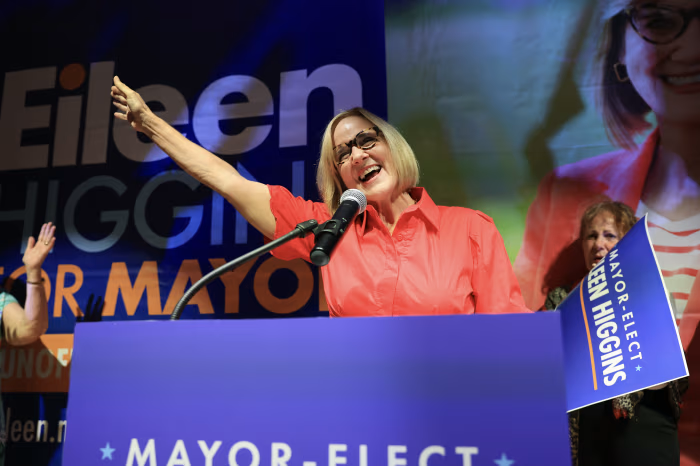
Miami’s December 9, 2025, runoff election was nothing short of historic — and it offers important lessons about democracy, voters’ voices, and how political winds can shift. Right from the start, the Miami runoff election drew widespread attention because the result would decide who leads the city after a long period of one-party dominance.
What happened in the Miami runoff election
After the general election held on November 4, 2025, did not produce a clear winner, the top two candidates advanced to a runoff on December 9. These candidates were Eileen Higgins and Emilio Gonzalez.
On the runoff day, voters returned to the polls and delivered a decisive verdict. Eileen Higgins won with roughly 59 % of the vote, while Gonzalez received about 41 %.
In doing so, Higgins became not only the first woman ever elected mayor of Miami, but also the first Democrat to hold the office in nearly three decades — since 1997.
Why this election matters
This election marks a big shift. For years, control of Miami’s city hall was governed by Republicans, but now the pendulum has swung. The victory of a Democrat over a Trump-endorsed Republican signals changing priorities among voters. Many Miami residents, especially from immigrant and Hispanic communities, resonated with Higgins’ emphasis on inclusion, affordable housing, and addressing local issues rather than just national partisan politics.
For example, in a city where many families worry about immigration enforcement and housing costs, Higgins’ campaign offered hope that local government would be more responsive to those concerns. That message appears to have struck a chord.
What we can learn from the Miami runoff election
The result of this election shows that local elections — even when officially nonpartisan — are shaped by the mood of the electorate, their hopes, fears, and what they care about in daily life. It’s a reminder that when people vote based on issues like housing, fairness, and inclusion rather than just party loyalty, change is possible.
Also, the election underlines the power of a runoff system: when no candidate gets a clear majority at first, a second round gives voters another chance to choose carefully. In this case, the runoff allowed for a clear winner who reflects widespread support.
Finally, this election is a signal to civic leaders everywhere that communities are ready for representation that reflects their changing demographics and evolving concerns.
What does this mean for the future of Miami?
With Eileen Higgins taking office, Miami may see renewed focus on inclusive policies and human-centred governance. The city could move toward prioritising affordable housing projects, fair treatment for immigrant communities, and efforts to rebuild trust in local government. For residents who felt forgotten or overlooked, the election result brings hope that their voices will now be heard.
At the same time, this change may draw attention from national political observers — because a city flipping after decades of one-party rule can affect broader political dynamics. For Miamiers, it likely means that city issues — not just national politics — will take the spotlight.
In short, the Miami runoff election of 2025 shows the power of voters, the importance of runoff elections, and how change is possible when people come together to make their voices heard.